Introduction
In the dairy industry, packaging does more than hold a product. It protects quality, supports transportation, communicates brand identity, and influences how customers perceive a product on the shelf. Whether a business sells curd, yogurt, lassi, buttermilk, or ice cream, the packaging can affect both operational efficiency and purchasing decisions.
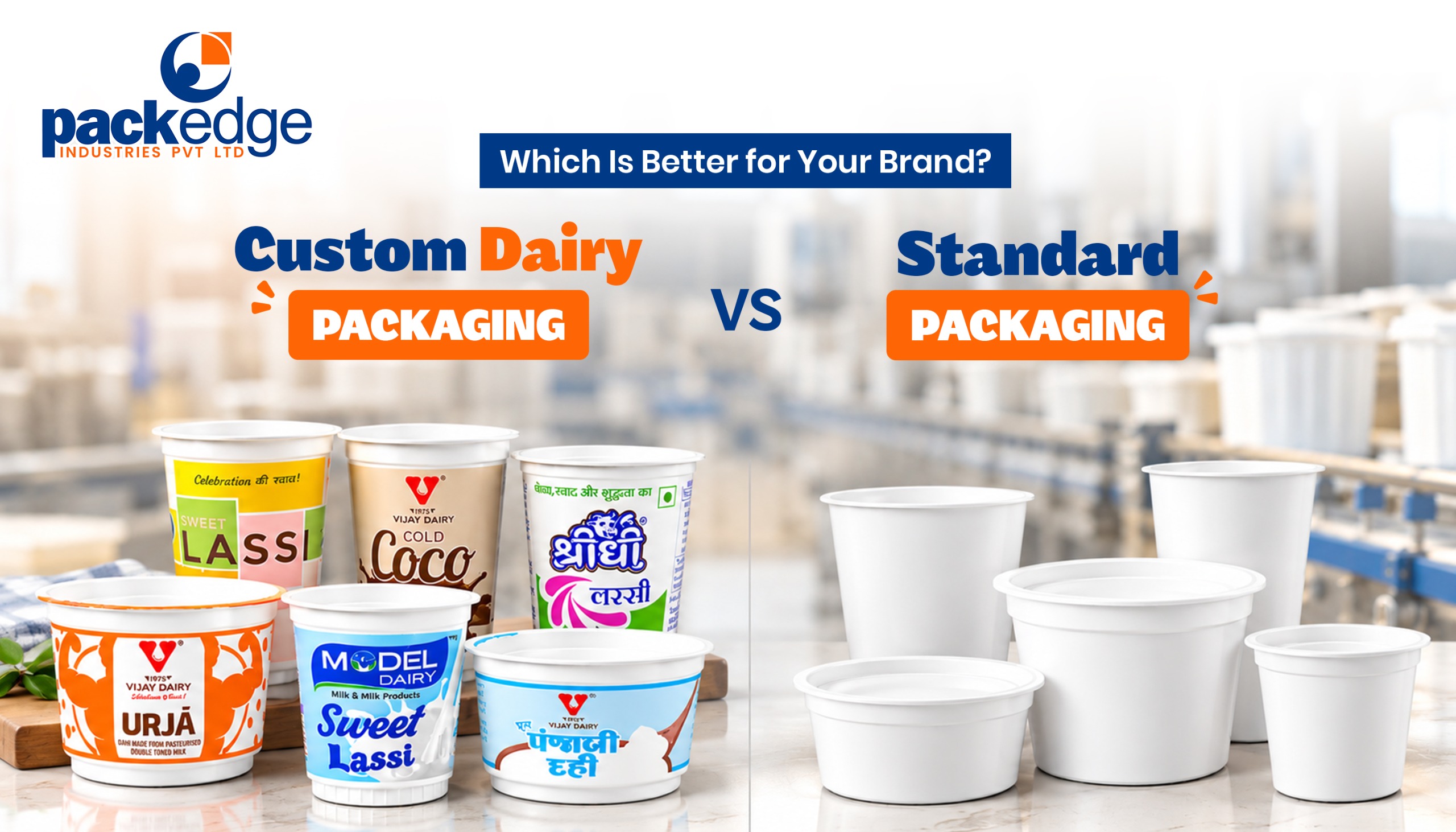
But when choosing dairy packaging, manufacturers often face an important question: should they invest in custom dairy packaging or choose standard packaging?
Standard packaging offers ready-made formats that can simplify purchasing and help businesses get started quickly. Custom dairy packaging, on the other hand, allows brands to explore designs, sizes, colours, and other features suited to their products and market positioning.
Neither option is automatically better for every business. The right choice depends on production volume, budget, product requirements, branding goals, and future growth plans.
In this guide, we compare custom dairy packaging and standard packaging to help manufacturers make an informed decision and understand which option may work best for their brand.
What Is Standard Dairy Packaging?
Standard dairy packaging refers to ready-made packaging formats manufactured in established sizes, shapes, and designs. These formats are available for a range of applications and can often be selected without developing a completely new packaging design.
For example, dairy businesses may use standard cups for yogurt and curd, established container formats for ice cream, or commonly available packaging for other dairy products.
Key characteristics of standard packaging
- Uses existing sizes and shapes.
- Usually requires fewer design changes before ordering.
- Can be suitable for businesses with straightforward packaging needs.
- May offer a simpler purchasing process.
- Can help businesses avoid some costs associated with developing new packaging formats.
Standard packaging can be a practical option for startups, regional dairy manufacturers, and businesses testing a new product in the market.
However, the available formats may limit how much a brand can differentiate its packaging from competing products. Businesses may also need to adapt their product presentation to the packaging formats available from their supplier.
What Is Custom Dairy Packaging?
Custom dairy packaging is developed or adapted to meet a brand’s specific requirements. Depending on the supplier’s capabilities, customisation may involve the packaging shape, dimensions, colours, printed design, lid arrangement, or other features.
The objective is to create packaging that suits the product while supporting the brand’s identity and operational requirements.
Key characteristics of custom packaging
- Packaging design tailored to specific business needs.
- Greater flexibility in branding and visual presentation.
- Potential to explore different sizes, shapes, and formats.
- Opportunities to align packaging with product positioning.
- Scope to address particular handling, storage, or production requirements.
For example, a yogurt brand targeting premium retail customers may want distinctive packaging colours and a consistent design across its product range. A dairy beverage manufacturer may prefer packaging that supports easy handling and clear product identification.
Customisation can help businesses create a more recognisable product, but it may involve additional design work, tooling, development time, or minimum order quantities, depending on the packaging format.
The final cost and feasibility should therefore be evaluated before making a decision.
Custom Dairy Packaging vs Standard Packaging: 7 Key Differences
1. Branding and Shelf Appeal
Packaging is often one of the first things customers notice when choosing a product. In a retail environment where several dairy brands compete for attention, clear and consistent presentation can help customers identify a product more easily.
How does standard packaging compare?
Standard packaging offers established shapes and sizes. Businesses can often use labels, stickers, or available printing options to add brand identity, depending on the format.
This can work well for brands that prioritise simplicity, cost control, and a familiar appearance.
However, if competing brands use similar packaging formats, visual differentiation may be more challenging.
How does custom packaging compare?
Custom dairy packaging offers greater opportunities to align the container’s appearance with the brand’s identity. Colours, printed designs, sizes, and selected structural features may be tailored to the product and target audience.
For example, a brand selling premium Greek-style yogurt may want a distinctive visual identity that communicates its positioning. A family-focused dairy brand may prefer a practical design with clear product information and recognisable colours.
Which is better?
Custom packaging may be more suitable when brand differentiation is a major priority. Standard packaging can still work effectively when supported by strong label design and consistent branding.
2. Initial Investment and Overall Cost
Budget is one of the most important factors in packaging decisions, especially for new businesses and manufacturers working with tight margins.
Standard packaging costs
Standard packaging may offer a lower initial investment because the basic packaging format already exists. Businesses may be able to select an available option without paying for a completely new design or specialised tooling.
This can make standard formats attractive for smaller orders, product trials, and businesses with limited budgets.
Custom packaging costs
Custom packaging can involve additional expenses, such as:
- Design and development.
- Specialised tooling or moulds, where required.
- Printing setup and artwork preparation.
- Minimum order quantities.
- Testing and production trials.
These expenses vary according to the level of customisation, material, production process, and supplier.
However, a custom format may become commercially attractive when order volumes are sufficiently high or when it delivers measurable operational or branding benefits.
Which is better?
Standard packaging is often a sensible starting point for businesses prioritising low upfront costs. Custom packaging may be worth considering when the expected benefits justify the additional investment.
Instead of comparing unit prices alone, evaluate the total cost, including setup, storage, transportation, waste, and production efficiency.
3. Flexibility in Sizes and Designs
Different dairy products have different packaging requirements. A single-serving yogurt cup, a family-sized curd container, and an ice cream tub do not necessarily need the same dimensions or structure.
Standard packaging offers established choices
With standard formats, businesses select from the sizes and designs available through their supplier. This can simplify purchasing, although the options may not match every product requirement exactly.
Manufacturers may need to adjust portion sizes, labels, or product presentation to suit the available format.
Custom packaging offers greater design freedom
Customisation can provide more flexibility in dimensions, appearance, and selected packaging features.
For instance, a manufacturer introducing several yogurt flavours may want a coordinated packaging system with different sizes or visual identifiers across the range.
However, additional design flexibility does not mean every custom feature is necessary. Unusual shapes or dimensions may increase production complexity or affect stacking, storage, and transportation.
Which is better?
Standard packaging is suitable when existing formats meet product requirements. Custom packaging is worth exploring when available formats cannot adequately support the product, customer needs, or brand identity.
4. Product Protection and Packaging Performance
Regardless of its appearance, dairy packaging must perform its primary function: protecting the product under the intended conditions of use.
Packaging performance depends on material suitability, structural strength, sealing quality, product compatibility, and storage requirements.
Standard packaging performance
Established packaging formats can provide dependable performance when their specifications suit the intended product and the supplier maintains consistent quality.
Businesses should still verify dimensions, lid compatibility, seal integrity, and performance under expected handling conditions.
Custom packaging performance
Custom packaging can be designed around particular product requirements. Depending on the application, this may allow manufacturers to address specific needs related to container stability, portion sizes, or closure arrangements.
However, custom packaging is not automatically stronger or safer than standard packaging. Both options require appropriate testing and quality checks.
For dairy products, manufacturers should also consider the complete storage and distribution system. Packaging cannot replace hygienic production, suitable processing, or the required cold chain.
Which is better?
The better option is the one that meets the product’s safety, protection, and handling requirements consistently. Businesses should compare verified performance rather than assuming that customisation guarantees better quality.
5. Production Efficiency and Compatibility
Packaging must work with the manufacturer’s production process. Even an attractive container can create problems if it does not fit existing filling, sealing, labelling, or packing equipment.
Standard packaging and production
Standard formats may be easier to introduce when they match the dimensions and specifications supported by existing machinery.
This can reduce the need for major equipment changes, although compatibility should always be confirmed.
Custom packaging and production
Custom formats may be developed around specific operational needs, but changes to dimensions or design can require equipment adjustments, new tooling, or production trials.
Before approval, manufacturers should evaluate:
- Compatibility with filling and sealing equipment.
- Container feeding and handling.
- Stacking and secondary packaging.
- Labelling or printing requirements.
- Expected production speed.
- Quality-control and rejection rates.
Which is better?
Standard packaging may be more convenient when a business wants to use existing production equipment with minimal changes. Custom packaging may be appropriate when the operational or branding benefits justify additional development.
A production trial is a valuable step before committing to either option in bulk.
6. Minimum Order Quantities and Inventory Management
Packaging purchases influence cash flow, warehouse space, and inventory planning. Businesses should consider how much packaging they need and how quickly they expect to use it.
Standard packaging
Standard formats may offer more practical purchasing options for some applications, depending on supplier availability and order policies.
They can be useful for businesses with seasonal demand, smaller production runs, or uncertain sales forecasts.
Custom packaging
Custom packaging may involve higher minimum order quantities, especially when specialised production or tooling is required.
Larger orders can sometimes improve unit economics, but they also require careful demand forecasting and storage planning.
Businesses should consider the risk of holding packaging for too long, particularly when designs change, product labels become outdated, or new product variants are introduced.
Which is better?
Standard packaging may suit businesses with lower or variable demand. Custom packaging may be more practical for manufacturers with predictable sales, established product lines, and sufficient storage capacity.
Always confirm minimum order quantities, lead times, and reorder schedules before finalising the purchase.
7. Sustainability and Long-Term Business Goals
Sustainability is becoming an important consideration for packaging buyers. However, choosing a more sustainable option requires looking beyond whether the packaging is custom or standard.
The environmental impact depends on factors such as material use, product protection, transportation, recyclability, and the waste-management systems available in the intended market.
Standard packaging and sustainability
Standard packaging may use established formats and production processes. Depending on the material and design, it may offer opportunities to manage material use and simplify sourcing.
Custom packaging and sustainability
Custom packaging can provide opportunities to review dimensions, reduce unnecessary material, or improve the efficiency of a packaging system.
However, specialised designs may also introduce additional materials or make recycling more difficult if they combine incompatible components.
Which is better?
Neither option is automatically more sustainable. Businesses should compare actual material requirements, packaging performance, transportation needs, and end-of-life options before deciding.
The aim should be to select packaging that supports environmental goals without compromising product protection or operational reliability.
How to Choose the Right Dairy Packaging for Your Brand
The best packaging decision starts with a clear understanding of your business requirements.
Before choosing custom or standard dairy packaging, consider these questions:
1. What type of dairy product are you selling?
Identify the product, portion size, storage temperature, shelf-life requirements, and expected handling conditions.
2. Who is your target customer?
Consider whether your product is aimed at budget-conscious consumers, families, premium retail customers, restaurants, or institutional buyers.
3. What is your production volume?
Estimate your monthly packaging requirement and expected business growth. This helps determine whether the investment in customisation is commercially practical.
4. What is your available budget?
Include setup costs, unit pricing, storage, transportation, and possible equipment adjustments in your calculations.
5. How important is product differentiation?
If distinctive packaging is central to your brand strategy, customisation may deserve greater consideration. If convenience and cost control are the priorities, standard packaging may be sufficient.
6. Can your supplier maintain consistent quality?
Review material specifications, sample quality, production capabilities, quality checks, and supply timelines before placing a bulk order.
People also want to know about custom dairy brand identity: Why Custom Dahi Cup Packaging Boosts Your Dairy Brand Identity?
Why Choose Packedge Industries for Dairy Packaging?
Choosing between custom and standard dairy packaging becomes easier when you work with a supplier that understands the importance of product requirements, brand presentation, and operational practicality.
Packedge Industries focuses on dairy packaging solutions for businesses looking to meet their product and packaging requirements.
Whether you are evaluating an existing packaging format or exploring options for a new product, the decision should consider more than appearance alone. Material suitability, container design, closure compatibility, production requirements, and commercial feasibility all play an important role.
How Packedge Industries can support your packaging decisions
- Application-focused discussions: Explain your product type, storage conditions, and intended use to evaluate suitable packaging options.
- Brand presentation: Explore options that support consistent colours, clear product identification, and a professional appearance.
- Practical packaging considerations: Review dimensions, container formats, closures, and handling requirements relevant to your application.
- Business-oriented planning: Discuss specifications, order quantities, and supply expectations before confirming your packaging choice.
Before placing a bulk order, discuss available formats, customisation possibilities, minimum order quantities, technical specifications, and lead times with the Packedge Industries team. Confirm which options are available for your particular application.
This approach helps you make a packaging decision based on your actual requirements instead of choosing solely on price or appearance.
Conclusion
Custom dairy packaging and standard packaging both offer advantages. Standard packaging can be a practical choice for businesses that want established formats, straightforward purchasing, and controlled upfront costs. Custom dairy packaging can provide greater flexibility in design, brand presentation, and selected product requirements.
The right choice depends on your production volume, target audience, budget, product protection needs, equipment compatibility, and long-term business plans.
For some manufacturers, standard packaging may be the right solution today, with customisation considered as the business grows. Others may benefit from investing in a distinctive packaging format from the beginning.
The key is to evaluate both options against clear quality and commercial requirements.
Looking for Dairy Packaging That Fits Your Brand?
Your packaging should support your product quality, reflect your brand identity, and make sense for your business operations.
Connect with Packedge Industries to discuss your dairy packaging requirements and explore suitable options for your product range. Whether you are launching a new dairy product or reviewing your existing packaging, the right conversation can help you identify a practical solution.
Learn more about Packedge Industries and discuss your packaging needs.